
Bowling lanes are not completely standard across all styles of bowling in North America. While ten-pin, five-pin, duckpin, and candlepin lanes share similar construction principles, their dimensions, pin placement, and sometimes surface specifications differ by discipline. This lesson focuses primarily on ten-pin bowling, which is the most common format.
Modern bowling lanes are made from a composite material commonly referred to as synthetic. Most manufacturers use very similar construction methods, and today’s synthetic lane panels can be produced in a variety of colours; these colour differences are aesthetic only and do not affect play.
Originally, bowling lanes were constructed entirely of wood. The front portion of the lane (from the foul line to approximately 40 feet) was made of hard maple, a dense wood that resisted wear and allowed the ball to glide more easily through the front part of the lane. The back end of the lane was made of pine, a softer wood that helped the ball create more friction and “hook” as it approached the pins. The lane surface was assembled from multiple narrow boards, glued and nailed together to form the full lane width.
Today, the appearance of individual boards is still visible on the lane, but these boards are printed onto the synthetic surface rather than being separate pieces of wood. These board markings are important because they are used for targeting and alignment, and they will be referenced in future lessons. Please keep this in mind.
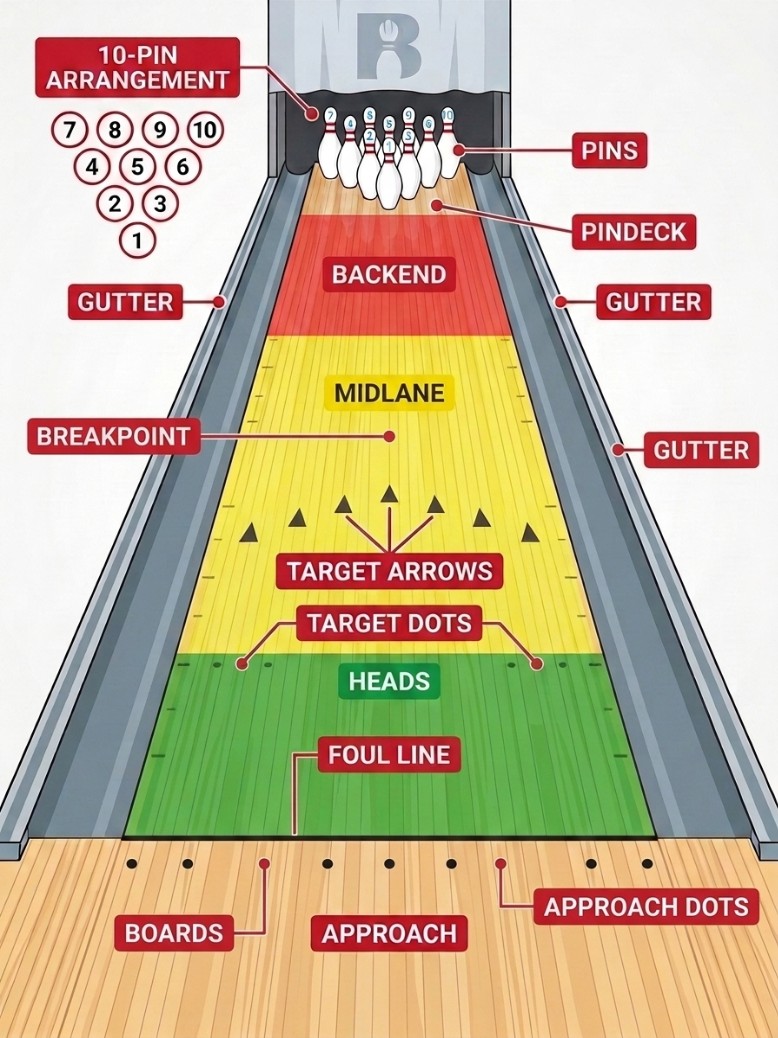
Lane Measurements:
- Length: 60ft
- Width: 41.5 inches (39 boards)
Terms regarding the lane:
- Pins
- Approach
- This is where the bowler will walk up to the foul line to execute their throw.
- Foul Line
- This is a black line at the start of the lane. If a bowler surpasses the line, they will get a (F) zero score for that shot.
- Boards
- Explained above
- Arrows
- Located at 15 ft from the foul line. Each arrow is 5 boards appart. The arrows are the most common object on the lane used for targeting.
- Dots
- There are dots located on the approach. Similar to the arrows, they are 5 boards appart. This is used to locate the bowler’s starting position in order to be consistent.
- There are dots also on the lane at 8 ft from the foul line. These are also used for targeting purposes, however less common than the arrows.
- Heads
- The first 1/3 of the lane, between the foul line and the arrows roughly.
- Midlane
- The second 1/3 of the lane, this is where we will see the ball start to curve if proper rotation is applied to the bowling ball.
- Back-end
- The last 1/3 of the lane, this is where the ball makes it direction towards the pins.
- Pin Deck
-
Pins: 10, numbered 1–10
-
Pin deck width: 41.5 inches (same as the lane)
-
Distance between pins (center to center): 12 inches
-
Formation: Equilateral triangle
-
Row 1: 1 pin (head pin)
-
Row 2: 2 pins, 12″ apart
-
Row 3: 3 pins, 12″ apart
-
Row 4: 4 pins, 12″ apart
-
-
Head pin to back pin (1 to 10): Approximately 48 inches diagonally
-